Ask five people in your organization what a Release Train Engineer does and you’ll get six answers. “They run PI Planning.” “They’re like a super Scrum Master.” “They send a lot of calendar invites.” “Honestly, I’m not sure.”
That ambiguity is the problem and the opportunity. The RTE role is one of the most misunderstood positions in scaled Agile. It’s also one of the most critical. If your ART is delivering inconsistently, drowning in dependencies, or treating PI Planning like a box-checking exercise, there’s a good chance the RTE function is either missing, misunderstood, or under-resourced.
Let’s fix the ambiguity. Here’s what RTEs actually do and why it matters for every PM and Scrum Master working at scale.
The One-Sentence Version
The RTE is a servant leader and coach for the Agile Release Train. They facilitate ART events and processes, and they help teams deliver value. That’s the SAFe definition, and it’s accurate, but it’s also abstract enough to mean almost anything. The real substance is in the five areas where RTEs spend their time.
The Five Responsibilities (In Plain Language)
SAFe organizes the RTE role around five core areas. Here’s what each one actually looks like in practice.
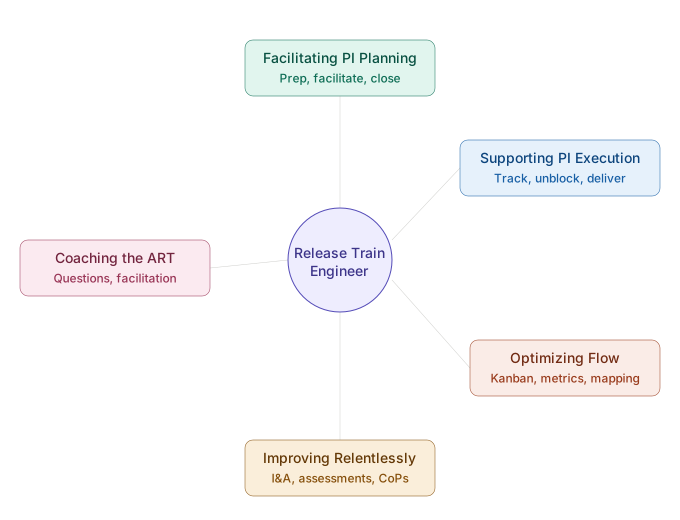
1. Facilitating PI Planning
This is the one everyone associates with the RTE role, and for good reason. PI Planning is the heartbeat of the ART, typically running every 8–12 weeks. But the RTE’s job isn’t just to stand at the front of the room and keep the agenda moving.
Before the event, the RTE ensures readiness across three fronts: the backlog is aligned with strategic priorities, leadership and teams are prepared with the right content, and the logistics (facilities, tooling, remote setup) are handled.
During the event, the RTE opens day one by setting the purpose, agenda, and working agreements. They introduce the business context and vision presenters. They run Coach Syncs during team breakouts. They oversee draft plan reviews. On day two, they facilitate planning adjustments, address ART-level PI risks, hold the confidence vote, and close the event with a retrospective.
If your PI Planning events feel chaotic or unproductive, start by looking at how much preparation the RTE is able to do upstream. The event itself is the tip of the iceberg.
2. Supporting PI Execution
PI Planning gets the attention. PI Execution is where the work happens, and where the RTE earns their keep.
During the PI, the RTE tracks feature completion across the ART backlog (typically visualized as a Kanban). They coordinate impediment removal, escalating problems that teams can’t resolve on their own. They facilitate recurring ART events: ART Sync, System Demos, and Inspect and Adapt.
They also manage PI-level risks and dependencies using the ROAM technique and the ART planning board. They support ART backlog refinement to keep work aligned with strategy. They promote DevOps practices and continuous delivery across the train, including helping define an ART-level definition of done. And they assist Business Owners with economic decision-making for epics, operating within lean budget guardrails.
If that sounds like a lot, it is. The RTE during PI Execution is essentially the connective tissue of the ART, the person making sure information flows, blockers get surfaced, and no team is silently stuck.
3. Coaching the ART
This is where the servant leadership mindset matters most. RTEs coach. They don’t direct. The shift from telling people what to do to helping them discover what to do themselves is the defining transition for anyone stepping into this role.
In practice, this means asking powerful, open-ended questions that drive reflection: What other possibilities exist? What are we not seeing? It means coaching the facilitation of ART and team events, helping Scrum Masters and Team Coaches create meaningful ceremonies, not just procedural ones. It means coaching ART leadership roles: Business Owners, System Architects, and Product Managers.
The RTE is a sounding board, a facilitation mentor, and sometimes the person who helps navigate a difficult conversation that no one else wants to have.
4. Optimizing Flow
This is the systems-thinking dimension of the role. RTEs are responsible for helping the ART achieve continuous value flow and that requires looking at the system, not just the teams.
They establish and maintain the ART Kanban system, visualizing all features in process and enforcing WIP limits. They track the six flow metrics, including flow predictability (how reliably the ART delivers against its plan) and flow time (how long it takes to deliver a feature end-to-end).
They facilitate value stream mapping to identify where handoffs, bottlenecks, and wait times are hiding. They review patterns from ART planning boards to spot recurring cross-team dependencies and work with stakeholders to eliminate them.
If your ART feels like it’s always busy but never fast, the flow optimization work is where the RTE should be spending more time.
5. Improving Relentlessly
Relentless improvement is one of SAFe’s four core values, and the RTE is the person most responsible for keeping that value alive on the ART.
They drive improvement through the Inspect and Adapt workshop; SAFe’s built-in problem-solving ceremony. They leverage Coach Syncs, PO Syncs, and communities of practice for just-in-time improvement throughout the PI. They periodically facilitate SAFe discipline and competency assessments to help teams increase their mastery of Lean-Agile practices.
They also collaborate with the Value Management Office (VMO) and the Lean-Agile Center of Excellence (LACE), connecting their ART’s improvement work to the broader organizational transformation strategy.
This is the long game. Any single improvement is incremental. The compounding effect over multiple PIs is where the real value shows up.
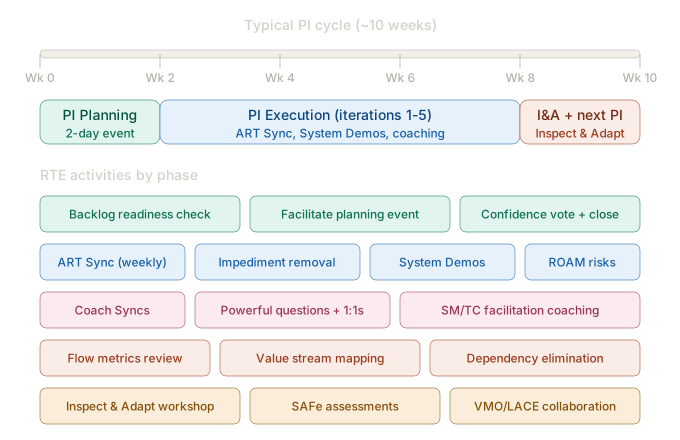
The timeline above maps the RTE’s five responsibility areas across a typical PI cycle.
PI Planning kicks things off with preparation, the event itself, and the confidence vote. During execution, the RTE runs weekly ART Syncs, clears impediments, facilitates System Demos, and manages risks using ROAM.
Coaching runs continuously: Coach Syncs, one-on-ones, and helping Scrum Masters and Team Coaches sharpen their facilitation. Flow optimization work (metrics reviews, value stream mapping, dependency elimination) happens in parallel.
The PI closes with Inspect and Adapt, SAFe assessments, and coordination with the VMO and LACE.
Note: this visual uses a 10-week PI for ease of viewing. Your organization’s PI cadence may differ. SAFe recommends 8–12 weeks, but the activity pattern stays the same regardless of length.
What the RTE Is Not
A few common misconceptions worth clearing up:
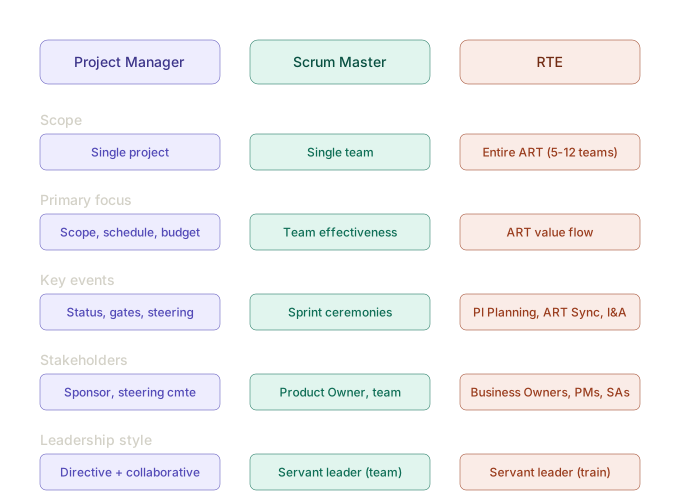
Not a project manager with a new title. The RTE doesn’t own scope, schedule, or budget in the traditional PM sense. They own the health and effectiveness of the ART as a system.
Not a super Scrum Master. Scrum Masters coach individual teams. RTEs coach the train, the team of teams. The scope, the stakeholders, and the organizational dynamics are fundamentally different.
Not an event coordinator. Yes, RTEs facilitate events. But facilitation is a means, not an end. The goal is value delivery, not meeting logistics.
The Talent Triangle Connection
For PMs looking at the RTE role through a PMI lens, here’s how the work maps:
| Talent Triangle Domain | RTE Connection |
|---|---|
| Ways of Working | Facilitating PI Planning, supporting PI Execution, establishing ART Kanban and flow metrics, promoting DevOps and continuous delivery |
| Business Acumen | Supporting economic decision-making for epics, operating within lean budgets, aligning backlog with strategy, tracking flow predictability against business objectives |
| Power Skills | Servant leadership, coaching with powerful questions, facilitating difficult conversations, navigating cross-team and cross-ART dependencies |
The RTE role is one of the most Talent Triangle-complete positions in scaled Agile. If you’re building breadth across all three domains, this is a role worth understanding, whether you pursue it or not.
Final Thought
The RTE role looks deceptively simple from the outside. Facilitate some events. Remove some blockers. Keep the train on the tracks. But the PMs and Scrum Masters who step into this role quickly discover that the real work is in the spaces between the events, the coaching conversations, the dependency patterns, the system-level thinking that turns a collection of teams into an actual train.
If someone asks you what RTEs do all day, the honest answer is: they make sure 50–125 people can deliver together. That’s harder than it sounds.
PDU Note: Writing and researching this post counts toward PMI’s Giving Back - Create Content. Research and prep time counts separately under Education — Informal Learning. The content maps to all three PMI Talent Triangle domains: Ways of Working (ART facilitation, flow optimization), Business Acumen (lean budgets, strategic alignment), and Power Skills (servant leadership, coaching, cross-functional collaboration).