I wore a Samsung Gear S3 for over ten years. That’s not a typo. While the rest of the smartwatch world cycled through annual upgrades and ecosystem lock-ins, I kept that rotating bezel on my wrist through firmware updates, battery swaps, and more charger cables than I care to remember. I loved that watch. The Gear S3 was ahead of its time, and I rode with it long after Samsung moved on.
Then Memorial Day happened. A trip to the beach, some water where water shouldn’t have been, and just like that, the Gear S3 was done. I didn’t choose to leave it. It left me.
So I did what most people do and picked up an Apple Watch. It was fine. It worked. But somewhere in that transition, with a new charger on the nightstand and a new ecosystem pulling at me, I realized I didn’t want to replace one smart leash with another. Every buzz on my wrist was still another inbox, another ping, another pull back into a screen. I didn’t need a watch that could do everything. I needed a watch that could tell time and take a beating. So I went looking, and I landed on a G-Shock Square.
Forty Years of Getting Hit
The Casio G-Shock DW-5600 has an origin story that sounds like marketing fiction but happens to be true. In 1983, a Casio engineer named Kikuo Ibe set out to build a watch that could survive a 10-meter drop onto a hard surface. The result was the original G-Shock, and the DW-5000C was its first form factor: the square. Casio proved the concept in a now legendary TV commercial where a professional hockey player launched the watch off a slapshot into a goalie’s glove. It survived. The square has been the foundation of the G-Shock lineup ever since.
That was over forty years ago, and the square hasn’t changed much in the ways that matter. The proportions are the same. The shock resistant resin case is the same. The philosophy, build something tough enough that you never have to think about it, is the same. What has changed is under the hood. The model I picked up, the DW-5600UE-1, is the latest revision of the classic 5600. Casio swapped out the old 3229 module for a new 3525, which replaces the electroluminescent backlight with an LED. That one change pushed the battery life from roughly two years to five. Not a flashy upgrade, but a practical one, and practical is the whole point of this watch.
Casio does make Bluetooth-enabled squares now. The DW-B5600 connects to your phone for auto time sync and app-based settings. The GW-B5600 adds solar power and radio time correction. And the DW-H5600 goes even further with heart rate monitoring, blood oxygen tracking, and notification mirroring. It’s a G-Shock square that’s one firmware update away from being a smartwatch. I’m sure they’re great watches. But, I didn’t leave a decade of smart devices on my wrist just to strap another one on. The whole point was to disconnect. The DW-5600UE doesn’t talk to my phone, doesn’t sync to an app, doesn’t need a charger. That’s not a limitation. That’s the feature.
Why the Square
I’d heard about G-Shocks for years. You can’t spend time around the military, law enforcement, or outdoor communities without someone eventually pulling up a sleeve and showing you theirs. But I never owned one. The bigger analog-digital models always felt like too much watch for me, and I never got around to trying the square.
When I decided to step away from smartwatches entirely, the DW-5600 kept coming up. It’s the entry point that serious watch people recommend. It’s the model that collectors with five-figure pieces still keep in their rotation as a daily beater. It’s the one that started it all. For under a hundred bucks, it felt like the right place to start.
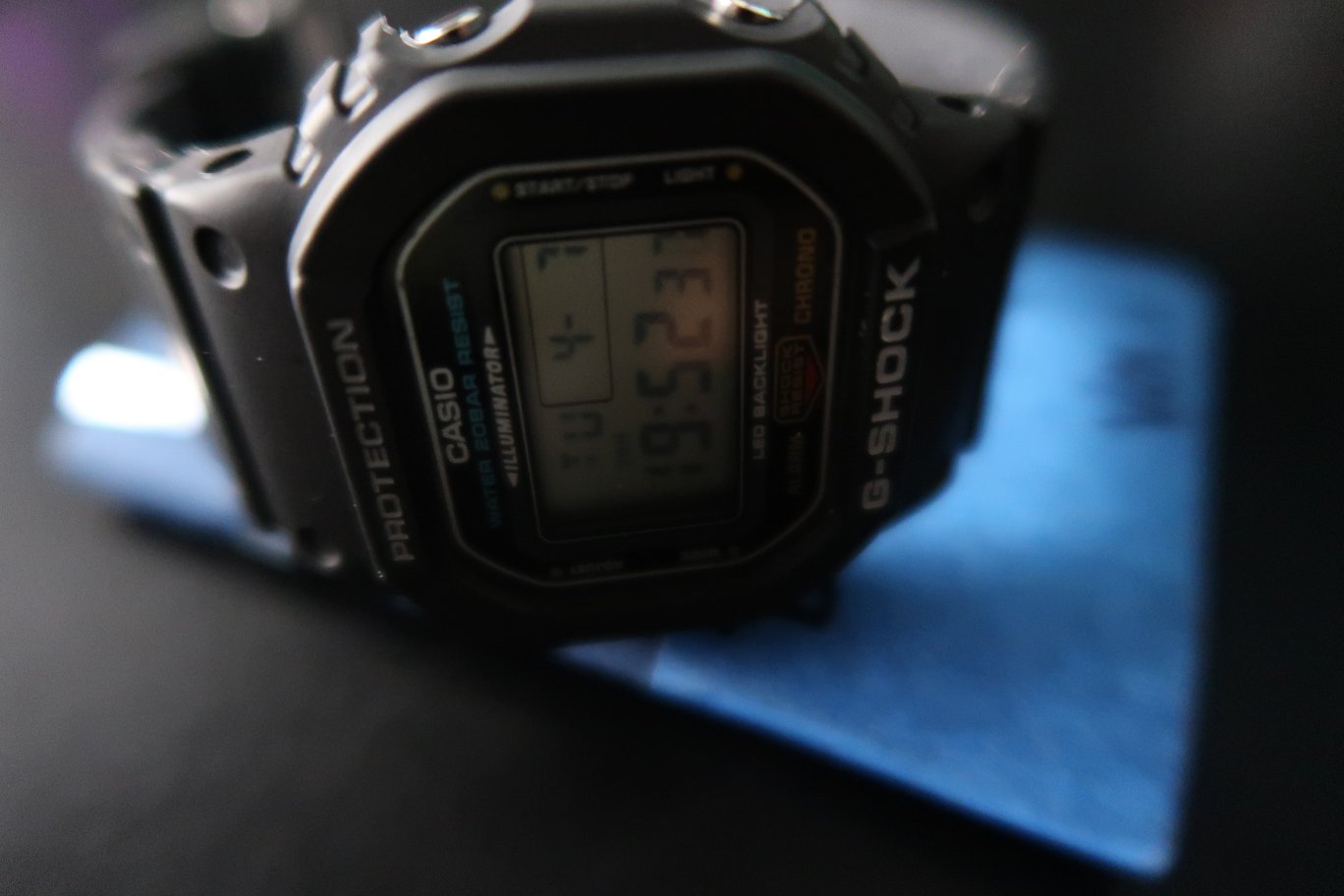
G-Shock DW-5600UE on messy desk
Living With It
I’ve had the DW-5600UE on my wrist for the better part of a year now, and the best thing I can say about it is that I forget it’s there. That’s not a knock. That’s the highest compliment a daily wear tool watch can earn.
It goes on in the morning and comes off at night. It handles yard work in a San Antonio summer without complaint. It travels without a charger, without a case, without a second thought. I don’t baby it. I don’t worry about bumping it into a door frame or catching it on a shelf. Two hundred meters of water resistance means I don’t take it off for anything involving water. The resin strap is comfortable enough to wear all day, and light enough that my wrist doesn’t feel bare when I’m not wearing it, but I also never feel weighed down.
The feature set is minimal and that’s the appeal. A stopwatch. A countdown timer. An alarm. A backlight. Time and date. That’s it. There’s no heart rate sensor, no step counter, no notification mirror, no app ecosystem. There’s nothing to configure, nothing to update, nothing to charge. You set the time once and walk away for five years.
What I Gained by Disconnecting
The smartwatch detox wasn’t really about the watch. It was about what the watch represented. A decade with the Gear S3 meant a decade of glancing at my wrist every time it buzzed. Emails, texts, calendar alerts, app notifications, all of it funneled to a small screen strapped to my arm. At some point I stopped choosing to look and started reacting on reflex. I didn’t see it clearly until the Gear S3 died and the Apple Watch took its place. Same habits, different ecosystem. That was the tell.
Taking it all away was quieter than I expected. No withdrawal, no FOMO. Just one less screen demanding attention throughout the day. My phone is still in my pocket, and I still check it, but it’s a deliberate action now. I pick it up, I look at it, I put it back. The wrist is just a watch again.
There’s also a bit of poetic justice in how this played out. The Gear S3 died from water damage at the beach. The watch that replaced it, after I got the smartwatch out of my system, is rated to 200 meters. Sometimes the universe tells you what you needed all along.
And there’s something to be said for wearing a piece with forty years of lineage behind it. The DW-5600 isn’t trendy. It isn’t trying to be. It’s a design that was perfected in the 1980s and has earned its place through sheer durability and function. There’s a quiet credibility to that. No smartwatch will ever have a forty-year track record because none of them are designed to last that long.
Up Next
I’m not done talking about the shift away from smart gear. The G-Shock Square started it, but it wasn’t the only watch that earned a permanent spot. Next up: the Casio Royale, a world timer with a cult following, a James Bond connection it never asked for, and a price tag that makes the whole smart vs. dumb debate feel ridiculous.