The MLB 2026 season is here. A few weeks ago I wrapped my fantasy baseball draft, where my team, Bat Country, is defending last year’s championship. I recently took over as commissioner of a league that’s been running for 20 years. And if inheriting two decades of league rules has taught me anything, it’s this: every rule you inherit was written to solve a problem. And half of those rules have created new ones.
Major League Baseball learned that lesson at scale. The 2022 collective bargaining agreement is a 300-page document that governs everything from minimum salaries to how many times a player can be sent to the minor leagues in a single season. But buried inside the economics and the legalese is something every project manager should study: a masterclass in what happens when your system creates the wrong incentives, and what it takes to fix them.
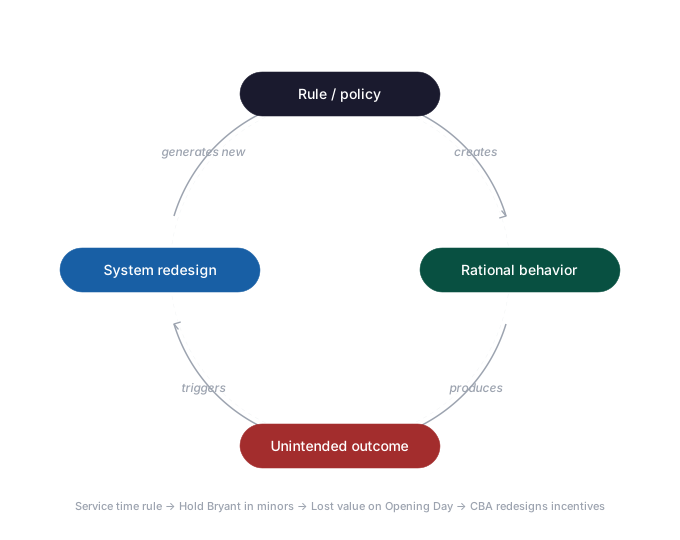
The core lesson is simple. When people game your process, the system is the problem. Not the people.
Quick Primer: What Is the CBA?
If you’re not a baseball fan, here’s what you need to know. The CBA (Collective Bargaining Agreement) is the labor contract between Major League Baseball’s 30 team owners and the MLB Players Association, the union representing every player on a 40-man roster. It sets the rules for how players get paid, how they move between teams, how the draft works, how revenue gets shared, and how disputes get resolved. Think of it as the operating agreement for a $11 billion enterprise with 30 semi-autonomous business units and 1,200 employees who also happen to be the product.
The current CBA was ratified in March 2022 after a 99-day lockout. It expires after the 2026 season. The negotiation was contentious because the previous agreement, signed in 2016, had created a set of incentives that led to widespread tanking, service time manipulation, and a decline in average player salaries even as league revenues grew. The 2022 CBA was an attempt to redesign those incentive structures. Some of those redesigns worked. Some created new problems. All of them are instructive for anyone who designs governance systems for a living.
Which, if you’re a PM, is exactly what you do.
PMBOK 7 called this Systems Thinking. PMBOK 8 made it the first principle: Adopt a Holistic View. The idea is the same. You can’t understand behavior by looking at individuals. You have to look at the system those individuals are operating in. The MLB CBA is one of the best real-world examples of that principle in action.
Note: If you’re curious about the current CBA structure that we’re going to talk about, you can find the current CBA below, hosted from the MLB Player’s Association site.
View the full PDF
The Kris Bryant Problem: When Your KPIs Reward the Wrong Behavior
In 2015, Kris Bryant was the number one prospect in all of baseball. The second overall pick in the 2013 draft (Thanks Houston…) out of the University of San Diego, where he won the Golden Spikes Award and the Dick Howser Trophy as the best amateur player in the country after leading the NCAA with 31 home runs. Arizona Fall League MVP in his pro debut. Then in 2014, he tore through Double-A and Triple-A, leading the minors with 43 home runs, 78 extra-base hits, a .661 slugging percentage, and a 1.098 OPS across 138 games, earning both the USA Today and Baseball America Minor League Player of the Year awards. Baseball America ranked him the number one prospect heading into 2015. He showed up to spring training and hit .425 with nine home runs in 40 at-bats, leading all of baseball. There was zero debate. He belonged on the Opening Day roster. But the Cubs sent him back to the minors for the first two weeks of the regular season.
Why? Because MLB’s service time rules said a player needed 172 days on the major league roster to earn a full year of service. Six years of service meant free agency. By holding Bryant in the minors for just 12 days, the Cubs gained an extra year of team control over him. They got to keep one of the best players in baseball for an additional season before he could negotiate on the open market.
Bryant filed a grievance. He lost. The arbitrator ruled the Cubs hadn’t technically broken any rules. And that’s the point. They hadn’t. The system made it rational to bench your best player on Opening Day.
If you’ve ever seen a team inflate story points to hit a velocity target, or a department burn remaining budget in Q4 so it doesn’t get cut next year, you’ve seen the same thing. The behavior looks wrong, but the incentive structure makes it logical. When smart people consistently do things that seem counterproductive, stop blaming the people. Look at the rules they’re operating under.
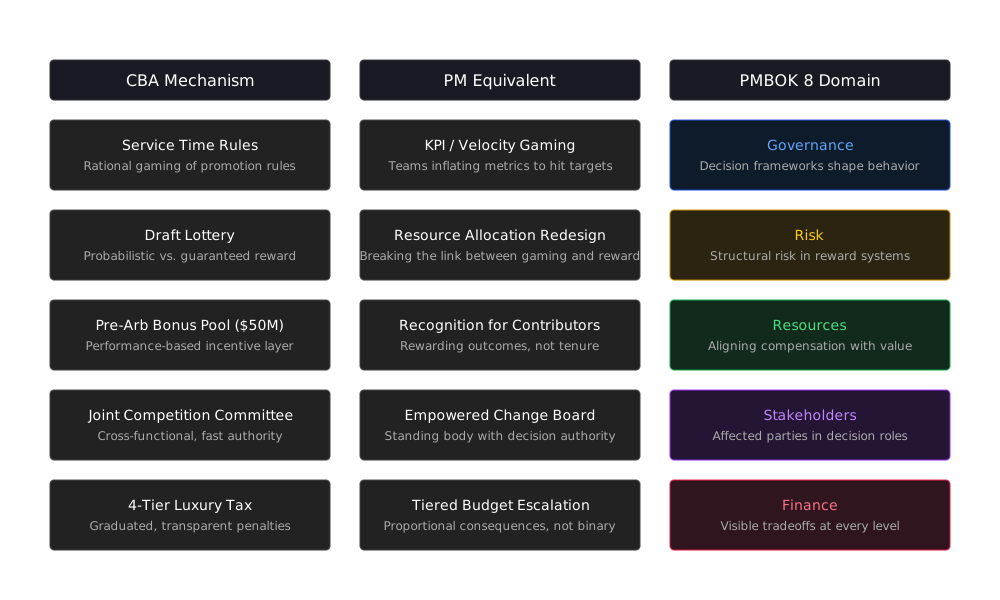
PMBOK 8’s Governance performance domain is relevant here. Governance covers the structures, policies, and decision frameworks that shape how people behave on your project. When governance is poorly designed, you get rational actors making irrational-looking decisions. The Cubs’ front office wasn’t failing at governance. The league’s governance was failing them by making the wrong choice the smart one.
The Draft Lottery: Governance That Makes Losing Unprofitable
The Bryant situation was one symptom. The bigger disease was tanking. Under the old system, the worst team in baseball got the first pick in the draft. This meant losing on purpose had a direct, measurable reward. Multiple teams slashed payroll, traded away talent, and fielded rosters they knew would lose 100 games because the draft pick at the end was worth more than the wins they were giving up.
The 2022 CBA introduced a draft lottery for the top six picks. The three worst teams each have a 16.5% chance at the number one selection, but it’s not guaranteed. Revenue-sharing teams can’t receive a lottery pick more than two years in a row. Non-revenue-sharing teams can’t get a top-six pick in consecutive years. A team that’s ineligible for the lottery can’t pick higher than tenth overall.
This is governance design, not punishment. The CBA didn’t ban tanking. It made tanking less profitable by breaking the direct link between losing and reward. The incentive to be terrible went from guaranteed to probabilistic. That’s a fundamentally different risk calculus for a front office.
PMBOK 8’s Risk performance domain addresses exactly this kind of structural risk. But most PMs think of risk as “what might go wrong on my project.” The CBA teaches a deeper lesson: sometimes the risk is baked into how the system distributes rewards. If your project governance rewards teams for sandbagging estimates, they’ll sandbag. If your resource allocation model gives more headcount to whoever screams loudest about being understaffed, everyone will scream. That’s not a team problem. That’s a Governance domain problem. You don’t fix this by telling people to stop gaming the system. You fix it by redesigning the system so gaming it doesn’t pay.
The Pre-Arbitration Bonus Pool: Paying for What You Actually Want
The service time problem had a second layer. Even when young players made it to the majors, they were stuck at the league minimum salary for their first three years regardless of performance. A rookie making $700,000 could be the best player in baseball and still have no leverage. The system paid veterans based on past performance and paid young stars based on how long they’d been around. Contribution and compensation were disconnected.
The 2022 CBA created a $50 million pre-arbitration bonus pool. After an initial awards phase, the remaining money gets distributed among the top 100 eligible players ranked by Joint WAR (Wins Above Replacement), as calculated by a Pre-Arbitration Committee. Each qualifying player’s share is proportional to their individual WAR relative to the total WAR of the top 100. It’s not a huge sum split across 100 players, but that’s not the point. The point is that the system now has a mechanism that connects measurable on-field value to compensation before arbitration kicks in.
PMBOK 8’s Focus on Value principle is directly relevant here. The principle says that outcomes, not just outputs, define success. The old MLB compensation model paid for outputs (years of service). The bonus pool pays for outcomes (statistical performance, value delivered). That’s the same shift PMBOK 8 is asking PMs to make. Stop measuring activity. Start measuring what the activity produces.
This is relevant to every PM who has watched a high performer on their project get the same annual review score as everyone else because “that’s just how the process works.” If your recognition system doesn’t differentiate based on contribution, it tells your best people that going above and beyond has no upside. They’ll stop doing it, or they’ll leave.
The CBA didn’t blow up the arbitration system. It added a targeted incentive layer on top. That’s the PM move too. You don’t always need to overhaul your entire performance framework. Sometimes you need a mechanism that visibly rewards the behavior you want, right now, before the formal process catches up.
The Competition Committee: Change Governance That Actually Ships
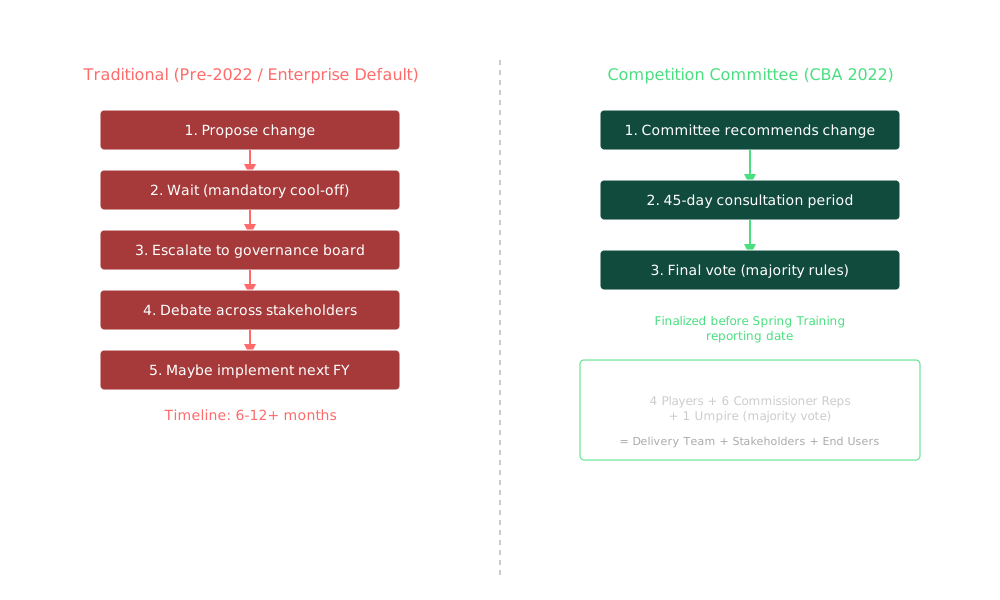
One of the most overlooked provisions in the 2022 CBA is the Competition Committee. It’s made up of four active players (including at least one pitcher and one non-pitcher), six members appointed by the Commissioner’s Office (one of whom serves as Chair), and one umpire appointed by the Umpires Association. By majority vote, this committee can adopt, revise, or repeal any playing rule that significantly affects players’ terms of employment.
Before this committee existed, significant rule changes required negotiation between the league and the union, a process that was slow, adversarial, and designed to protect the status quo. The Competition Committee replaced it with a standing body that has cross-functional representation and a structured process: the committee recommends a change, a 45-day consultation period follows, and then the committee reconvenes for a final vote. All changes must be finalized before the mandatory Spring Training reporting date for that season.
PMBOK 7 had a principle called Tailoring: the idea that processes should be adapted to fit the project context. PMBOK 8 takes this further with its five Focus Areas, which are explicitly designed to be “development-approach agnostic,” applicable across predictive, adaptive, and hybrid environments. The Competition Committee embodies this. It’s a governance structure built for speed and adaptability, not for one specific way of doing things.
If you’ve ever tried to get a process change approved through three layers of steering committees and a quarterly governance board, you understand why this matters. The old MLB model is the same model most enterprises use for change management: propose, wait, debate, escalate, wait more, maybe implement next fiscal year. The new model puts the right people in a room with decision-making authority and a defined timeline.
The composition matters too. Players, management, and an umpire. That’s the equivalent of putting your delivery team, your stakeholders, and your end users on the same change board. PMBOK 8’s Stakeholders performance domain emphasizes exactly this: that the people affected by decisions should have a role in making them. It doesn’t eliminate disagreement, but it forces the disagreement to happen in one room instead of across six email threads over four months.
The Luxury Tax Tiers: Graduated Consequences Beat Binary Penalties
The CBA’s Competitive Balance Tax starts with a Base Tax Threshold ($230 million in 2022) and adds three Surcharge Thresholds at $250 million, $270 million, and $290 million. Exceed the base, and you pay a tax rate that depends on how many consecutive years you’ve been over. First-time payors pay 20%. Second-time payors pay 30%. Third-time and beyond pay 50%. Cross a surcharge threshold and additional rates stack on top, climbing as high as 110% on dollars above $290 million for repeat offenders. Exceed the second surcharge threshold and your highest draft pick gets moved back ten places in the next draft.
This is graduated governance. The CBA doesn’t say “you’re over budget, you’re in trouble.” It says “here’s what it costs you at each level, and the cost accelerates.” Teams can make an informed decision about whether exceeding the threshold is worth it in a given year. Some teams, like the Mets, have decided the penalty is worth paying. That’s their call, and the system accounts for it.
PMBOK 8’s Finance performance domain (which replaces the old Cost Management knowledge area) aligns with this thinking. The Finance domain focuses on understanding the financial implications of decisions and making tradeoffs visible. The luxury tax model does exactly that. It makes the cost of every incremental dollar transparent and lets decision-makers choose their risk level with full information.
Compare this to how most projects handle budget overruns. It’s usually binary: you’re on budget or you’re not. There’s a green status and a red status. There’s no mechanism for a team to consciously choose a controlled overrun with transparent tradeoffs.
A graduated model gives you escalation without panic. Tier one might mean a conversation with your sponsor. Tier two means a formal change request. Tier three means scope reduction or timeline extension. Tier four means executive intervention. Each step is defined, proportional, and known in advance. People make better decisions when consequences are visible and scaled, not hidden behind a single red/green toggle.
CBA Mechanisms and Their PM Equivalents
The PM Talent Triangle Connection
| Talent Triangle Domain | CBA Connection |
|---|---|
| Ways of Working | Governance design: draft lottery mechanics, change committee structure, graduated escalation models, PMBOK 8 Focus Areas applied to incentive redesign |
| Business Acumen | Incentive economics: how compensation structures drive behavior, ROI of system redesign vs. enforcement, Finance domain tradeoff visibility |
| Power Skills | Stakeholder alignment across competing interests, designing rules that survive contact with rational actors, building empowered cross-functional decision bodies |
Final Thought
The 2022 MLB CBA is a 300-page case study in a principle every PM needs to internalize: when people game your system, the problem is the system.
The Cubs didn’t manipulate Kris Bryant’s service time because they were villains. They did it because the rules made it the rational choice. Teams didn’t tank because they lacked competitive spirit. They tanked because the draft rewarded losing. Young stars didn’t underperform. The compensation structure just didn’t notice when they overperformed.
Every one of those problems has a direct parallel in project management. Inflated estimates. Sandbagged commitments. Budget gaming. Status report theater. The people doing those things aren’t broken. The systems they’re operating in are.
PMBOK 7 called it Systems Thinking. PMBOK 8 calls it Adopt a Holistic View. The MLB CBA calls it a 99-day lockout and a complete structural overhaul. Whatever you call it, the lesson is the same: fix the system, and the behavior follows.
After inheriting a fantasy league with 20 years of history and defending a championship with Bat Country, I can tell you: the commissioner’s job and the PM’s job are the same. Design the rules so the game rewards what you actually want. Then get out of the way.
Play ball.
Disclaimer: Just a fan’s interpretation of the CBA. I might be off. This is for fun, drawing parallels between baseball and project management principles. Not gospel.
This post was created as part of my ongoing recertification under PMI’s Giving Back to the Profession: Create Content category. Writing and publishing original content in your area of professional practice is a qualifying PDU activity. This post addresses all three domains of the PMI Talent Triangle: Ways of Working (governance design, change management structures, PMBOK 8 Focus Areas and performance domains applied to incentive frameworks), Business Acumen (incentive economics, compensation-to-behavior alignment, Finance domain tradeoff visibility, ROI of structural redesign), and Power Skills (cross-functional stakeholder alignment, designing systems that account for competing interests, building empowered decision bodies per PMBOK 8’s Stakeholders domain).