Here is a little known fact I tend to pull out whenever I walk past a store counter or a vendor with a bowl full of Dum Dums. That mystery flavor wrapped in the question mark is not a top secret recipe somebody cooked up in a lab. It is a manufacturing decision, and a pretty smart one.
If you have ever unwrapped a Mystery Flavor and tried to guess what it is, you are usually tasting two completely different flavors that ran into each other on the line.
The decision behind it
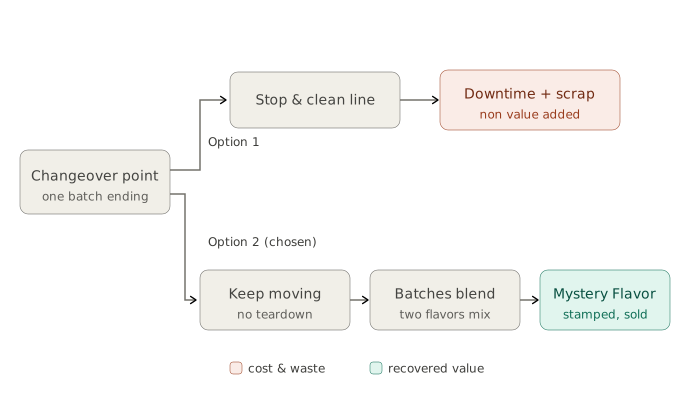
When the Spangler Candy Company, the makers of Dum Dums, finishes one flavor batch and needs to start the next, they have two options:
- Stop the line, purge and clean out the machinery, and bring it back up running the new flavor.
- Keep the line moving and let one batch run straight into the next.
To keep throughput up, they choose to keep it moving. As the tail end of one batch, say Cream Soda, is wrapping up, the front end of the next batch, say Blue Raspberry, is already being pushed into the same equipment. For a short window the two candy liquids mix together. Instead of pulling that in between product off the line and tossing it, they stamp it out and package it in the question mark wrapper.
Because the line runs through roughly sixteen standard flavors on a rotation, the mystery flavor is never one fixed thing. It depends entirely on which two batches happened to cross paths, which is why it tastes different from bag to bag.
Why I can’t let this go
This is the part that gets me, and it is where my prior life as a manufacturing engineer (and a Dum Dum enthusiast) kicks in. Strip the candy away and look at what is actually happening on that line.
Every flavor change is a changeover. A full, proper changeover means stopping production, purging the equipment, cleaning it down so the next flavor does not pick up the last one, and bringing the line back to steady state. All of that is non value added time. While the vats are being cleaned, the line is not producing a single sellable piece of candy. In a continuous process, downtime like that is one of the most expensive things you can have, because the cost of the equipment and the labor keeps running whether product is coming off the end or not.
Then there is the transition material itself. In a lot of continuous processes, the slug of product caught between two batches is off spec for both. It is not fully the old flavor and not fully the new one, so the standard move is to purge it and scrap it. That is yield you paid for in raw material, energy, and machine time, and then threw in the bin.
Spangler looked at both of those costs and made a different call. They avoid the changeover downtime by not stopping, and they recover the transition material by selling it instead of scrapping it. The thing that would normally be waste becomes a product with its own little fan base. That is about as clean a piece of waste reduction as you will find, and they got a marketing hook out of it on top.
What it actually buys them
Three things, in plain terms:
- Uptime. No full teardown and cleaning between every flavor means the line keeps producing. Less downtime, more pieces per shift.
- Yield. The transition product that would normally be scrap gets packaged and sold. The sugar, syrup, and machine time that went into it are recovered instead of written off.
- Demand. The question mark turns a process necessity into something people actually look for in the bag. You rarely get to convert a waste stream into a feature customers ask for by name.
None of this requires a secret. It is just a company deciding that the cheapest, lowest waste path through a changeover was also the more interesting one for the customer.
Try it yourself
Pick two flavors and see what collision you would have pulled out of the bag. Sixteen flavors gives you well over a hundred possible pairings, which is roughly why no two mystery Dum Dums taste quite the same.
Start of the line
So the next time you grab a Mystery Flavor out of a bowl, you might be tasting a clean split of Fruit Punch and Cotton Candy, or just a hint of Grape fading into Butterscotch. Either way, you are tasting a changeover, and somebody upstream decided not to waste it.
- Jeff