I had a great discussion this week with a peer about how large scale efforts seem so distant without any type of supporting work structure. This made me think, Where does this separation come from? Who are these people that draw up these ideas? What’s the thought process into this? This made me start thinking of the two conflicting personality types I’ve encountered in my professional career: the realist and the visionary.
Every planning room has two kinds of voices. The visionary describes a far goal, one big enough that nobody can see the whole path to it yet. The realist describes what has to happen first, the nearer goals that are outlined, achievable, and necessary before the far goal is even possible.
These voices are often treated as opposites, as if one dreams and the other says no. That misreads the realist. A good realist doesn’t argue the vision down. They take it seriously enough to ask what it depends on, then point the work at those dependencies first.
The people who meet in the middle hold both at once. They keep the far goal intact as the direction and organize the work as a sequence of nearer goals that build toward it. The result is an idealized vision with the future in mind, attached to a path that can actually be walked.
Planning through both lenses shapes the work differently than planning through either one alone.
The visionary lens
Visionary planning starts at the destination. It names a far goal and describes the world once that goal is reached. The goal can have real structure, with a clear outcome, a sense of who benefits, and a rough shape of what it takes. What it doesn’t have yet is a first step.
That lens is valuable. A far goal gives a team a reason to care about the work beyond the next deliverable. It surfaces options a near-term plan would never consider, and it gives every smaller decision something to point toward.
Through this lens alone, work tends to stretch toward the impossible. The goal is clear, but the path isn’t, so teams either stall at the starting line or try to build the end state directly. Plans fill with outcomes nobody knows how to begin.
The realist lens
Realist planning starts from what has to be true. It looks at a goal and works backward, asking what capability, knowledge, or groundwork has to exist before this is possible. The answers become nearer goals, each one outlined, sized, and achievable.
That lens is just as valuable. Realism turns a goal from something to admire into something to work on. It finds the dependencies, puts them in order, and gives a team goals it can actually reach and build on.
Through this lens alone, with no far goal to work backward from, work becomes outlined and capable but aimless. Near goals get chosen because they’re achievable, not because they lead anywhere in particular. The team makes steady progress, and nobody can say what it adds up to.
Meeting in the middle
The people who meet in the middle combine the two lenses into one plan. The visionary supplies where the work is going. The realist supplies the order it gets there in.
In practice, the far goal stays whole. Nobody trims it to make the plan feel safer. Instead, the realist question gets asked of it directly. What has to be true before this is possible? The answers become the first set of nearer goals, and the work starts there.
Each near goal earns its place in two ways. It’s achievable now, which satisfies the realist. And it’s a prerequisite for the far goal, which satisfies the visionary. A goal that meets only one of those tests doesn’t belong in the plan yet.
This top-down breakdown is what makes the work clear. Every near goal is defined, and every one of them traces directly to the far goal. Teams know exactly what they’re working on and why it matters. Leaders and stakeholders can see how each piece of work connects to the destination. And when a near goal is reached, the team knows precisely how far it moved the plan, which makes finishing the work satisfying. Clarity, transparency, and satisfaction all come from the same place. The work is defined in relation to the end goal.
One goal, worked backward
Picture a team whose far goal is to release to production any day it chooses.
Through the visionary lens alone, that goal becomes the deliverable. It lands on a roadmap as a single item, and the team doesn’t know where to start, because the item describes an end state rather than work.
Through the realist lens alone, the team never states the far goal. It speeds up the slowest manual step in the release, then the next one. Each fix is solid, but the fixes don’t build on each other, and the larger outcome never comes into view.
Through both lenses, the far goal stays exactly as stated, and the realist question gets asked of it. What has to be true first? Automated tests need to cover the critical paths. Deployment needs to run through one automated pipeline. Feature flags need to separate deploying code from releasing it. Those become the near goals, in order, because each one makes the next possible.
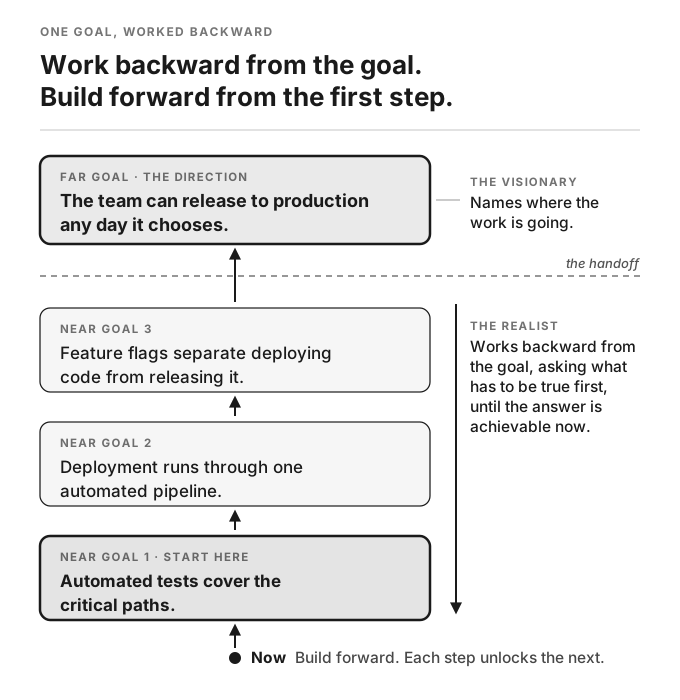
The team starts on the first one. When it’s reached, the team knows more about the second, and the far goal is closer than it was.
The handoff is where plans change shape
Between the far goal and the first near goals there’s a handoff, the moment a vision gets broken into goals a team is accountable for. This is where planning tends to go wrong, and it breaks in one of two directions.
The first break is handing the far goal down whole. The vision crosses the handoff as the deliverable itself, often with a date attached, instead of being broken into the nearer goals it depends on. A team ends up accountable for an outcome nobody has decomposed, and progress stalls before the first step is even defined.
The second break runs the other way. The far goal gets judged by what fits right now. Someone raises a bold direction, the first step looks too big for the current cycle, and the whole goal gets dropped. The goal was never the problem. It needed to be worked backward into something smaller to start on.
Both breaks come from the same mistake, which is treating the far goal and the near goals as the same kind of statement. The far goal is a direction. The near goals are commitments. A planning process that keeps them distinct, and connects them deliberately, avoids both failures.
Planning through both lenses
A few practices make the combination work.
- Name the far goal first. Before anyone sizes anything, state the destination in plain terms. A plan without one has nothing to work backward from.
- Work backward to prerequisites. Ask what has to be true before the far goal is possible, then ask it again of each answer. Stop when the answers are goals the team can actually reach.
- Sequence the near goals. Order matters. Each near goal should make the next one possible, so the path reads as a chain, not a list.
- Keep the far goal and the commitments in separate places. The far goal describes direction. The near goals describe what the team will deliver. When both carry the same weight in the same document, the direction gets read as a deadline.
- Let each near goal inform the path. Reaching a near goal teaches something about the ones after it. Revisit the sequence as goals are reached, and keep the far goal steady while the path toward it sharpens.
The people in the middle
The planners who meet in the middle hold an idealized vision with the future in mind, and they build the path to it out of goals that can actually be reached, starting with the nearest. Breaking the far goal down from the top gives every piece of work a clear purpose, makes progress visible to everyone, and gives the team the satisfaction of seeing each step move the plan forward.
The vision says where. Realism says what comes first. Work takes its best shape when both are in the same plan.
- Jeff